


 China
China
China's top 10 weather and climate events in 2025
On January 29, 2026, the China Meteorological Administration (CMA) released the selection results of the Top 10 Domestic and International Extreme Weather and Climate Events in 2025 during the monthly press conference.
·Top 10 Extreme Weather and Climate Events in China
1. Record-high annual hot days, with a fierce "autumn tiger" hitting the regions south of the Yangtze River and South China
In 2025, the national average number of high-temperature days in China reached 16.5 days, which is 7.4 days more than the normal, marking the highest level since 1961. Six provinces — Shanxi, Shaanxi, Shandong, Henan, Hubei, and Jiangxi — all recorded record-high numbers of high-temperature days.
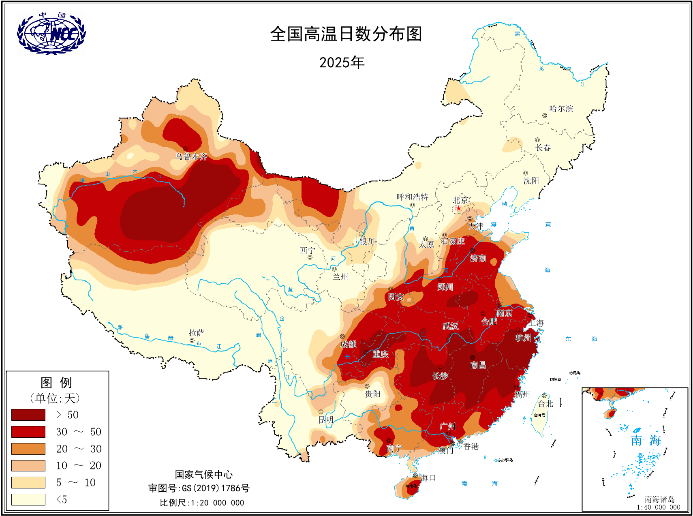
Distribution of high-temperature days across China in 2025
2. An extended rainy season in North China, setting multiple historical records
The North China rainy season in 2025 saw the earliest start, the longest duration, and the highest cumulative rainfall since 1961. It began on July 5, which is 13 days earlier than the long-term average. The rainy season lasted for 59 days, which is 29 days longer than the average. The total rainfall during this period was 356.6 mm, 1.6 times more than the average.
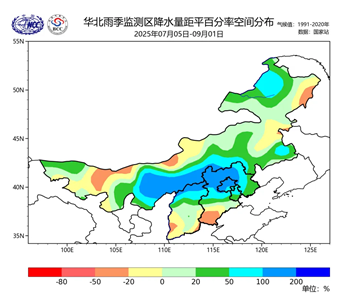
Precipitation distribution in North China during the 2025 rainy season
3. Intensive and widespread torrential rains in northern China, causing severe floods in many areas
In 2025 summer, northern China experienced numerous heavy rainstorms with strong local extremity, leading to severe floods. From July 23 to 29, many areas in North China were hit by severe rainstorms and flooding. The Chaobai River recorded its largest flood since 1959. In early August, multiple areas in Gansu saw regional heavy rainfall, triggering severe rainstorm-induced flooding disasters.
4. Super Typhoon Ragasa made three landfalls, bringing violent winds and heavy rains
The strongest typhoon over the western North Pacific in 2025 was Typhoon Ragasa, which reached a peak intensity of above 62 m/s and maintained the super typhoon level for over 81 hours. Ragasa made three landfalls in southern China on September 24—25, bringing strong winds and heavy rainfall to southern and eastern China.
5. Successive droughts in South China, Henan-Shaanxi regions and the Huanghuaihai Plain, with severe local disasters
A winter-spring continuous drought occurred in South China and the middle and lower reaches of the Yangtze River region, particularly in Guangxi. During the transition from spring to summer, drought developed rapidly in the eastern part of Northwest China, the HuangHuai region, and eastern Sichuan. In July, high temperatures and low rainfall persisted in the HuangHuai and Jianghuai regions, affecting the growth of autumn grain crops.
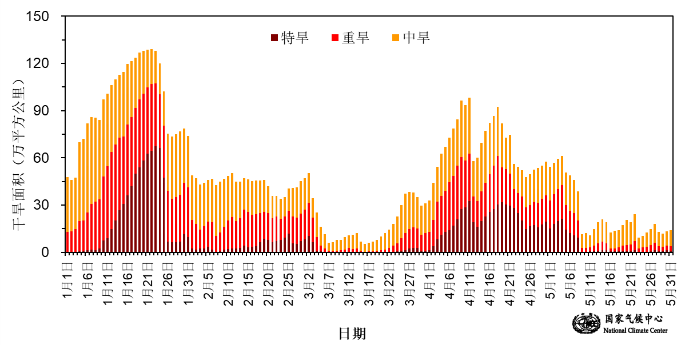
Daily changes in the area affected by meteorological drought across nine provinces (Guangdong, Guangxi, Hainan, Hubei, Hunan, Jiangxi, Anhui, Jiangsu, and Zhejiang) from January to May 2025
6. Typhoon Matmo disrupted the dual festivals, prompting the CMA to issue a red warning
Typhoon Matmo made landfall in Guangdong and Guangxi on October 5 to 6, 2025. It was the strongest typhoon to make landfall on mainland China in 2025 bringing heavy rain and strong winds to the coastal areas of South China.
7. Nine cold waves swept across China throughout the year, with a roller-coaster temperature swings in early spring
In 2025, a total of 30 cold air processes affected China, nine of which were cold waves (3.7 more than the long-term average). In March, two nationwide cold wave events occurred, including the strongest cold wave of the year from March 25 to 30, leading to large fluctuations in temperature.
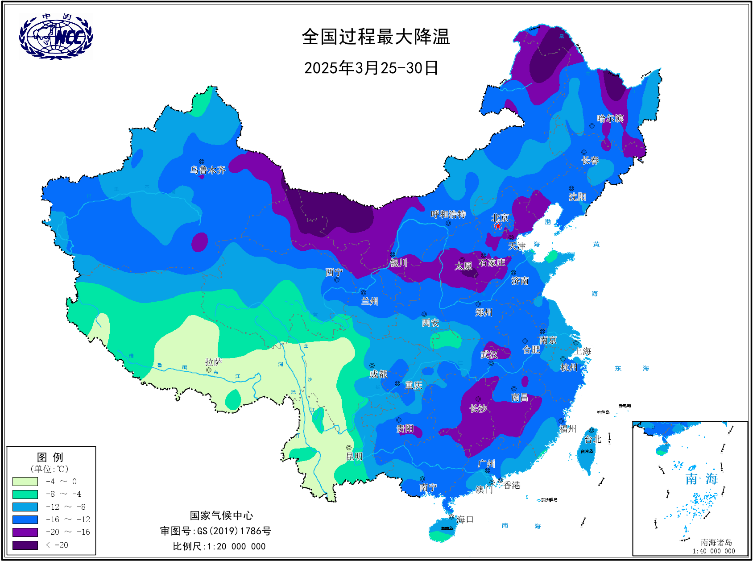
The maximum cooling during the cold air event from March 25 to 30, 2025
8. Record-breaking gales hit many areas in April, triggering the largest-scale sand and dust weather in a decade
From April 10 to 14, gusts of above level 12 occurred in 23 provinces. The maximum wind speeds at 64 national meteorological stations broke historical records. Beijing issued its first citywide orange gale warning in nearly a decade. Meanwhile, the largest sandstorm in nearly a decade swept across central and eastern China, covering an area of over 4.3 million square kilometers. The sand and dust traveled as far south as Hainan.
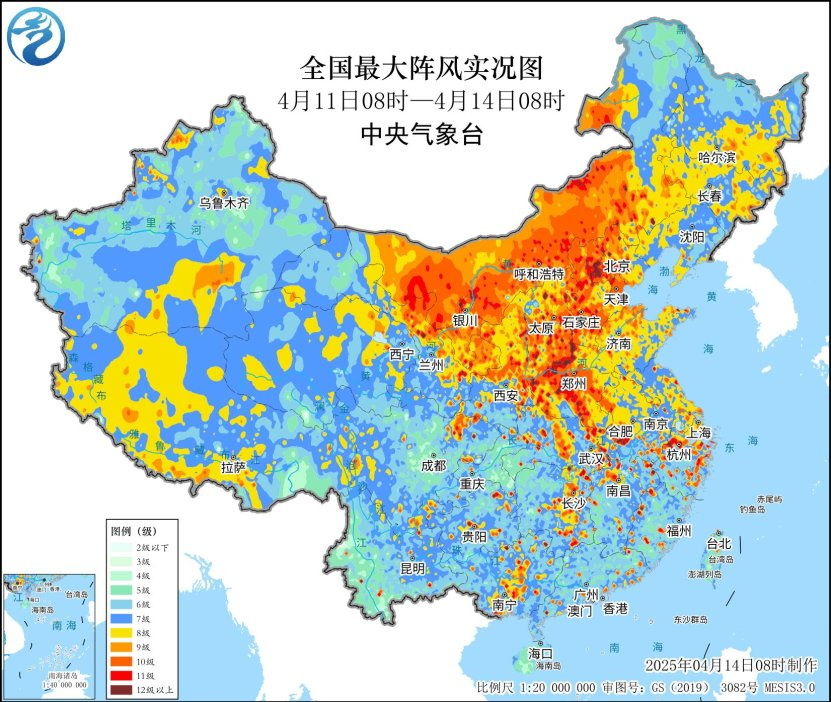
Observed maximum gusts across China from April 11 to 14, 2025
9. Endless autumn rains delayed the autumn harvest and sowing from West China to the Huanghuai region
The 2025 autumn rainy season in West China began on August 25 and ended on November 11, lasting a total of 78 days, which is 16 days longer than normal. The cumulative rainfall was 387.1 mm, nearly double the long-term average, marking the highest amount since 1961. The autumn harvest and sowing from West China to the HuangHuai region was significantly delayed.
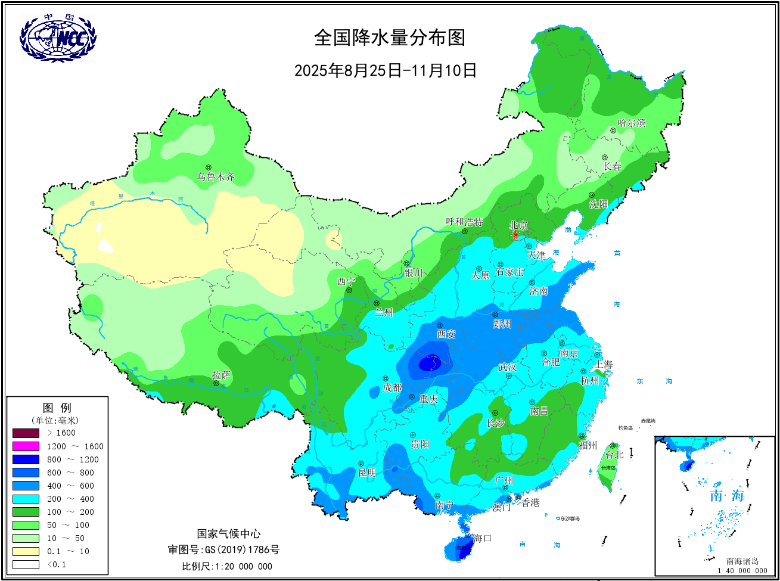
Precipitation distribution across China during the 2025 West China autumn rainy season
10. Ten tropical cyclones hit Guangdong, equaling the historical record; three successive landfalls in September caused abnormal winds and rains
Ten tropical cyclones made landfall in or severely affected Guangdong Province in 2025, which is 4.2 more than normal, tying with 1961 as the most in history. Among them, six made landfall in Guangdong. In September, three typhoons (Tapah, Mitag, and Ragasa) made landfall in Guangdong one after another within 16 days.
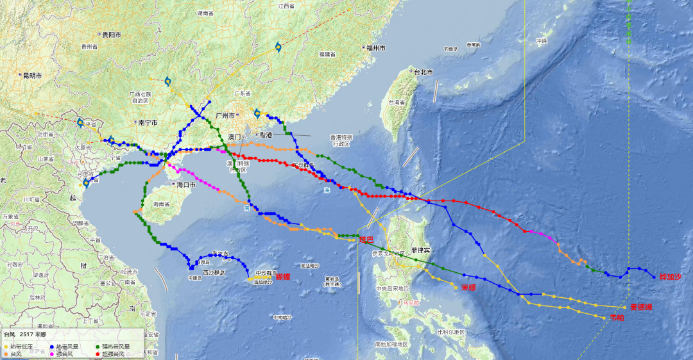
The moving paths of the six typhoons that made landfall in Guangdong in 2025
Hosted by the CMA and organized by the National Climate Centre of CMA, the selection was jointly supported by the National Meteorological Centre of CMA, National Satellite Meteorological Centre of CMA, CMA Public Meteorological Service Centre, and CMA Meteorological Communication and Outreach Centre (China Meteorological News Press).
Launched in 2004, this annual event has been successfully held for 22 consecutive years. It aims to raise public awareness of meteorological disasters and extreme weather and climate events, enhance the initiative in meteorological disaster prevention as well as the awareness of self-rescue and mutual rescue, and improve the whole society's capacity for meteorological disaster defense.