

 Global
Global top 10 weather and climate events in 2025
On January 29, 2026, the China Meteorological Administration (CMA) released the selection results of the Top 10 Domestic and International Extreme Weather and Climate Events in 2025 during the monthly press conference.
·Top 10 International Extreme Weather and Climate Events
1. Century-rare heavy rainfall hit Texas, the US, triggering severe flash floods
From late on July 3 to early on July 4, 2025, central Texas received up to 406 mm of rain. A once-in-a-century downpour triggered flash floods, washing away roads and homes. Over 100 people died, with many missing, including dozens of children at a summer camp.
2. Heatwaves battered Europe, leading to massive power outages and fatal wildfires
In late April and June 2025, record heat hit Europe: Spain and Portugal saw temperatures approaching 47°C, causing blackouts and over 1,000 heat-related deaths. Wildfires broke out across Greece, France, and Cyprus, destroying tens of thousands of hectares of forest.
3. Melissa, the world's strongest tropical cyclone, inflicted heavy damage on the Caribbean region
In October 2025, Category 5 Hurricane “Melissa” intensified from 113 to 295 km/h in 24 hours — a record. It devastated Jamaica and Haiti, killing dozens, destroying power grids, and displacing tens of thousands.
4. Record-breaking blizzards struck Japan, with snow depth exceeding 4 meters in some areas
In early February 2025, a severe cold wave brought record snow to Japan. Obihiro recorded 129 cm in 12 hours, and snow depths exceeded 4 meters. The snow paralyzed transport, triggered avalanches, and caused over 10 deaths and 170 injuries.
5. Frequent solar storms posed threats to aerospace safety
During Solar Cycle 25’s peak in 2025, frequent solar storms caused an Airbus A320 uncommanded dive, leading to a grounding. In November, X-class flares and a severe geomagnetic storm disrupted a NASA Mars orbiter launch and created widespread auroras.
6. Twin storms in Mexico caused catastrophic floods
In early October 2025, Tropical Storms “Priscilla” and “Raymond” hit central and eastern Mexico, causing catastrophic flash floods. Over 100 people were killed or missing, and infrastructure was severely damaged. Rescue operations lasted for days.
7. Global warming continued, and the United Nations Climate Change Conference forged global consensus
The 2025 global average temperature was 1.40°C above pre-industrial levels — the third warmest year on record. COP30 in Belém, Brazil, adopted the “Global Mobilization” agreement, building consensus on mitigation, adaptation, and climate finance.
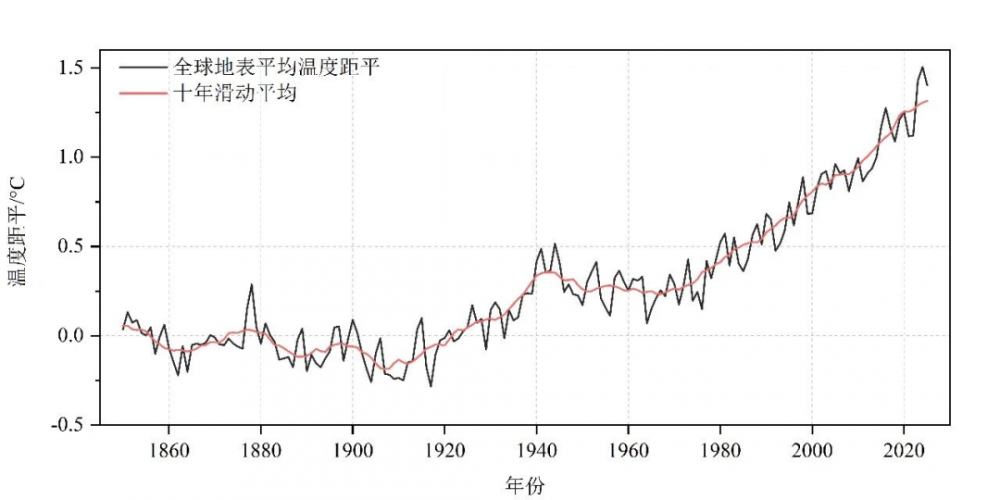
The global average surface temperature anomaly time series from 1850 to 2025 (relative to the average from 1850 to 1900)
8. Storm Senyar triggered deadly natural disasters, killing over 1,000 people on Sumatra Island
From late November to early December 2025, Tropical Storm “Senyar” triggered extreme rainfall over Sumatra, Indonesia. Widespread flooding and landslides killed over 1,000 people, left more than 100 missing, and affected 3.3 million — Indonesia’s worst disaster since 2018.
9. The worst floods in 60 years hit Nigeria hard
On May 28, 2025, heavy rain hit Niger State, causing the worst flooding in 60 years. At least 200 people died, over 500 went missing, and more than 3,000 were displaced. Houses, bridges, and roads were destroyed.
10. Iran suffered its driest autumn in half a century, sparking a water supply crisis
Autumn 2025 was Iran’s driest in 50 years; Tehran saw its lowest rainfall in a century. After six consecutive drought years, major dams are at ~10% capacity. Lake Urmia has nearly dried up, causing a severe water supply crisis.
Hosted by the CMA and organized by the National Climate Centre of CMA, the selection was jointly supported by the National Meteorological Centre of CMA, National Satellite Meteorological Centre of CMA, CMA Public Meteorological Service Centre, and CMA Meteorological Communication and Outreach Centre (China Meteorological News Press).
Launched in 2004, this annual event has been successfully held for 22 consecutive years. It aims to raise public awareness of meteorological disasters and extreme weather and climate events, enhance the initiative in meteorological disaster prevention as well as the awareness of self-rescue and mutual rescue, and improve the whole society's capacity for meteorological disaster defense.